Product Description
Product Description
Quick details
Gland —-High grade ductile iron
Tube —–Cold drawn honed tubling
Piston—–High grade ductile iron
Piston rod—-Chromed C45
Piston seal—-Urethane seal
End cap—-Casting seel
Mounting style—-Pins and clips included
Gland seals—-Polyurethane U-cup
Rod wiper—-Urethane snap in
Paint color—-Semi-gloss black, grey, red
1.Light-weight,high strength
Base on the nature of construction work,the hydraulic cylinders need to suit for high strength,high
using frequency,high fatigability.to promise the sability and reliablity of application.
2.the seal system
select the excellent seal kits from japan and germany.adopt the advanced physical design,make
sure the hydraulic cylinder get the best piston rod oil film
3.cylinder body
adopt the good-quality alloy honed tube,though cold-drawing and rolling,to reach an excellent
toughness and surface hardness.improve the wear-resistance.
4.piston rod
middle frequency induction hardening and tempering,chrome plated on rod surface to improve the
anti-rust ,wear-resistance and anti-scratch property.
5.safety/cushioning fuction
The inside of cylinder set up an cushioning device in the end of stroke,it can absorb the juge inpact.
Technical Specification size.
|
cylinder diameter (mm) |
piston rod diameter (mm) |
max stroke (mm) |
||
|
40 |
20 |
22 |
25 |
500 |
|
50 |
25 |
28 |
32 |
600 |
|
63 |
32 |
35 |
45 |
800 |
|
80 |
40 |
45 |
55 |
2000 |
|
90 |
45 |
50 |
63 |
2000 |
|
100 |
50 |
55 |
70 |
4000 |
|
110 |
55 |
63 |
80 |
4000 |
|
125 |
63 |
70 |
90 |
4000 |
|
140 |
70 |
80 |
100 |
4000 |
|
150 |
75 |
85 |
105 |
4000 |
|
160 |
80 |
90 |
110 |
4000 |
|
180 |
90 |
100 |
125 |
4000 |
|
200 |
100 |
110 |
140 |
4000 |
|
220 |
110 |
125 |
160 |
4000 |
|
250 |
125 |
140 |
180 |
4000 |
Cylinder tube machining
Piston
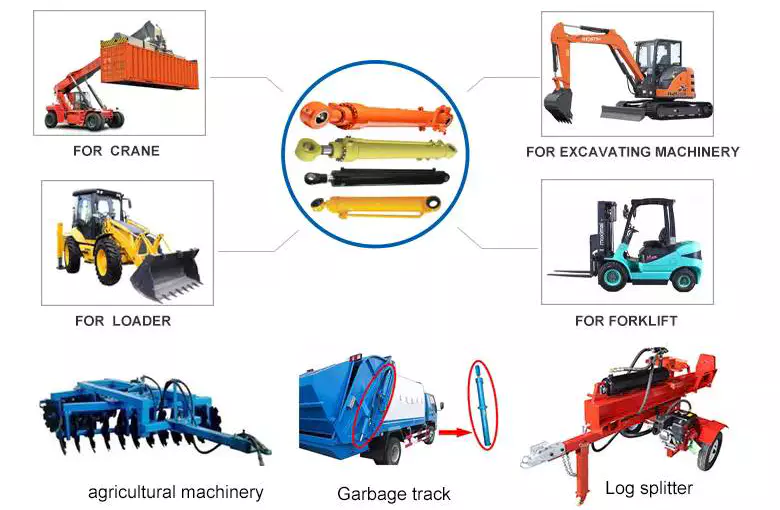
Application boom cylider, stick cylinder, Dozer cylinder.
| Excavator Type | Name | Stroke (mm) | Installation Diameter(mm) | Cylinder Diameter(mm) | Rod Diameter(mm) |
| 5.5T | Boom Cylinder | 710 | 1120 | 115 | 65 |
| Stick Cylinder | 815 | 1210 | 90 | 55 | |
| Bucket Cylinder | 605 | 945 | 85 | 55 | |
| Dozer Cylinder | 150 | 500 | 110 | 60 | |
| 6.5T | Boom Cylinder | 885 | 1311 | 110 | 65 |
| Stick Cylinder | 900 | 1300 | 90 | 60 | |
| Bucket Cylinder | 730 | 1120 | 80 | 50 | |
| Dozer Cylinder | 145 | 565 | 130 | 70 | |
| 11.5T | Left Boom Cylinder | 980 | 1480 | 100 | 70 |
| Right Boom Cylinder | 980 | 1480 | 100 | 70 | |
| Stick Cylinder | 1571 | 1530 | 115 | 80 | |
| Bucket Cylinder | 885 | 1375 | 95 | 65 | |
| 18.5T | Left Boom Cylinder | 1195 | 1790 | 120 | 85 |
| Right Boom Cylinder | 1195 | 1790 | 120 | 85 | |
| Stick Cylinder | 1405 | 2000 | 130 | 95 | |
| Bucket Cylinder | 1110 | 1630 | 110 | 80 | |
| 20T | Boom Cylinder | 1285 | 1870 | 120 | 85 |
| Stick Cylinder | 1490 | 2075 | 135 | 95 | |
| Bucket Cylinder | 1120 | 1680 | 115 | 80 | |
| 23T | Boom Cylinder Assembly | 1295 | 1870 | 130 | 90 |
| Stick Cylinder Assembly | 1675 | 2225 | 140 | 100 | |
| Bucket Cylinder Assembly | 1156 | 1744 | 130 | 90 | |
| 26T | Boom Cylinder Assembly | 1420 | 1980 | 139 | 100 |
| Stick Cylinder Assembly | 1748 | 2348 | 149 | 110 | |
| Bucket Cylinder Assembly | 1130 | 1753 | 134 | 100 | |
| 40T | Boom Cylinder Assembly | 1495 | 2135 | 160 | 110 |
| Stick Cylinder Assembly | 1790 | 2480 | 170 | 110 | |
| Bucket Cylinder Assembly | 1285 | 1990 | 160 | 110 |
Q: Are you trading company or manufacturer ?
A: We are factory.
Q: How long is your delivery time?
A: Generally it is 5-10 days if the goods are in stock. or it is 15-20 days if the goods are not in stock, it is according to quantity.
Q: Do you provide samples ? is it free or extra ?
A: Yes, we could offer the sample for free charge but do not pay the cost of freight.
Q: What is your terms of payment ?
A: Payment 30%TT in advance. 70% T/T before shippment
| Certification: | GS, RoHS, CE, ISO9001 |
|---|---|
| Pressure: | High Pressure |
| Work Temperature: | Normal Temperature |
| Acting Way: | Single Acting |
| Working Method: | Straight Trip |
| Adjusted Form: | Switching Type |
| Samples: |
US$ 30/Piece
1 Piece(Min.Order) | |
|---|
| Customization: |
Available
|
|
|---|
Can hydraulic cylinders be used for precise operations like CNC machining or molding?
Yes, hydraulic cylinders can be used for precise operations like CNC machining or molding. While hydraulic systems are commonly associated with heavy-duty applications, they can also provide the necessary precision and control required for precise operations in CNC machining and molding processes. Here’s a detailed explanation of how hydraulic cylinders can be utilized for such precise operations:
1. Force and Control:
– Hydraulic cylinders are capable of generating substantial force, which is essential for precise operations in CNC machining and molding. By using hydraulic pressure, the cylinders can deliver the required force to cut or shape materials accurately or exert pressure for molding operations. The hydraulic system allows precise control over the force applied, ensuring consistent and reliable performance.
2. Adjustable Speed and Positioning:
– Hydraulic cylinders offer adjustable speed and precise positioning capabilities, making them suitable for precise operations. By controlling the flow of hydraulic fluid, the speed of the cylinder’s movement can be adjusted according to specific requirements. This adaptability allows for fine-tuning the machining or molding process, achieving the desired precision in material removal or shaping. Hydraulic systems also enable accurate positioning of tools or molds, ensuring precise operations.
3. Integrated Feedback Systems:
– Advanced hydraulic systems can incorporate feedback sensors and control mechanisms to enhance precision in CNC machining and molding. These sensors provide real-time information about the position, speed, and force exerted by the hydraulic cylinders. The control system processes this data and adjusts the flow of hydraulic fluid accordingly, allowing for precise and accurate control over the operations. The feedback systems help maintain consistent performance and compensate for any deviations, ensuring high precision.
4. Damping and Vibration Control:
– Hydraulic cylinders can be equipped with damping mechanisms to minimize vibrations and ensure stability during CNC machining or molding operations. Vibrations can negatively impact precision by causing tool chatter or material deformation. By incorporating cushioning or damping features, hydraulic cylinders help absorb shocks and suppress vibrations, resulting in smoother and more accurate operations.
5. Customization and Adaptability:
– Hydraulic cylinders can be customized and adapted to meet the specific requirements of CNC machining or molding processes. Engineers can design cylinders with unique dimensions, stroke lengths, mounting options, and sealing arrangements to fit into equipment or systems with precise specifications. Customized hydraulic cylinders ensure optimal performance and compatibility for precise operations, enabling seamless integration into CNC machines or molding equipment.
6. Energy Efficiency:
– Hydraulic systems can be designed to be energy-efficient, contributing to cost savings in CNC machining or molding operations. By utilizing variable speed pumps, efficient control valves, and well-designed hydraulic circuits, energy consumption can be optimized. This efficiency reduces heat generation, leading to improved stability and precision in operations while minimizing energy costs.
7. Maintenance and Calibration:
– Regular maintenance and calibration of hydraulic systems are essential to maintain their precision in CNC machining or molding applications. Proper lubrication, inspection of seals, and replacement of worn-out components help ensure optimal performance. Regular calibration of control systems and feedback sensors ensures accurate readings and reliable operation, contributing to precision in machining or molding processes.
In summary, hydraulic cylinders can be effectively used for precise operations like CNC machining or molding. Their ability to generate substantial force, adjustable speed and positioning, integration with feedback systems, damping and vibration control, customization and adaptability, energy efficiency, and proper maintenance contribute to achieving the required precision in these operations. By leveraging the strengths of hydraulic systems, manufacturers can enhance the accuracy and reliability of CNC machining or molding processes, resulting in high-quality products and improved productivity.
Integration of Hydraulic Cylinders with Equipment Requiring Rapid and Dynamic Movements
Hydraulic cylinders can indeed be integrated with equipment that requires rapid and dynamic movements. While hydraulic systems are generally known for their ability to provide high force and precise control, they can also be designed and optimized for applications that demand fast and dynamic motion. Let’s explore how hydraulic cylinders can be integrated with such equipment:
- High-Speed Hydraulic Systems: Hydraulic cylinders can be part of high-speed hydraulic systems designed specifically for rapid and dynamic movements. These systems incorporate features such as high-flow valves, optimized hydraulic circuitry, and responsive control systems. By carefully engineering the system components and hydraulic parameters, it is possible to achieve the desired speed and responsiveness, enabling the equipment to perform rapid movements.
- Valve Control: The control of hydraulic cylinders plays a crucial role in achieving rapid and dynamic movements. Proportional or servo valves can be used to precisely control the flow of hydraulic fluid into and out of the cylinder. These valves offer fast response times and precise flow control, allowing for rapid acceleration and deceleration of the cylinder’s piston. By adjusting the valve settings and optimizing the control algorithms, equipment can be designed to execute dynamic movements with high speed and accuracy.
- Optimized Cylinder Design: The design of hydraulic cylinders can be optimized to facilitate rapid and dynamic movements. Lightweight materials, such as aluminum alloys or composite materials, can be used to reduce the moving mass of the cylinder, enabling faster acceleration and deceleration. Additionally, the cylinder’s internal components, such as the piston and seals, can be designed for low friction to minimize energy losses and enhance responsiveness. These design optimizations contribute to the overall speed and dynamic performance of the equipment.
- Accumulator Integration: Hydraulic accumulators can be integrated into the system to enhance the dynamic capabilities of hydraulic cylinders. Accumulators store pressurized hydraulic fluid, which can be rapidly released to supplement the flow from the pump during high-demand situations. This stored energy can provide an extra boost of power, allowing for faster and more dynamic movements. By strategically sizing and configuring the accumulator, the system can be optimized for the specific rapid and dynamic requirements of the equipment.
- System Feedback and Control: To achieve precise and dynamic movements, hydraulic systems can incorporate feedback sensors and advanced control algorithms. Position sensors, such as linear potentiometers or magnetostrictive sensors, provide real-time position feedback of the hydraulic cylinder. This information can be used in closed-loop control systems to maintain precise positioning and execute rapid movements. Advanced control algorithms can optimize the control signals sent to the valves, ensuring smooth and dynamic motion while minimizing overshooting or oscillations.
In summary, hydraulic cylinders can be integrated with equipment that requires rapid and dynamic movements by utilizing high-speed hydraulic systems, employing responsive valve control, optimizing cylinder design, integrating accumulators, and incorporating feedback sensors and advanced control algorithms. These measures enable hydraulic systems to deliver the speed, responsiveness, and precision necessary for equipment operating in dynamic environments. By leveraging the capabilities of hydraulic cylinders, manufacturers can design and integrate systems that meet the requirements of applications demanding rapid and dynamic movements.

How do hydraulic cylinders generate force and motion using hydraulic fluid?
Hydraulic cylinders generate force and motion by utilizing the principles of fluid mechanics, specifically Pascal’s law, in conjunction with the properties of hydraulic fluid. The process involves the conversion of hydraulic energy into mechanical force and linear motion. Here’s a detailed explanation of how hydraulic cylinders achieve this:
1. Pascal’s Law:
– Hydraulic cylinders operate based on Pascal’s law, which states that when pressure is applied to a fluid in a confined space, it is transmitted equally in all directions. In the context of hydraulic cylinders, this means that when hydraulic fluid is pressurized, the force is evenly distributed throughout the fluid and transmitted to all surfaces in contact with the fluid.
2. Hydraulic Fluid and Pressure:
– Hydraulic systems use a specialized fluid, typically hydraulic oil, as the working medium. This fluid is stored in a reservoir and circulated through the system by a hydraulic pump. The pump pressurizes the fluid, creating hydraulic pressure that can be controlled and directed to various components, including hydraulic cylinders.
3. Cylinder Design and Components:
– Hydraulic cylinders consist of several key components, including a cylindrical barrel, a piston, a piston rod, and various seals. The barrel is a hollow tube that houses the piston and allows for fluid flow. The piston divides the cylinder into two chambers: the rod side and the cap side. The piston rod extends from the piston and provides a connection point for external loads. Seals are used to prevent fluid leakage and maintain hydraulic pressure within the cylinder.
4. Fluid Input and Motion:
– To generate force and motion, hydraulic fluid is directed into one side of the cylinder, creating pressure on the corresponding surface of the piston. This pressure is transmitted through the fluid to the other side of the piston.
5. Force Generation:
– The force generated by a hydraulic cylinder is a result of the pressure applied to a specific surface area of the piston. The force exerted by the hydraulic cylinder can be calculated using the formula: Force = Pressure × Area. The area is determined by the diameter of the piston or the piston rod, depending on which side of the cylinder the fluid is acting upon.
6. Linear Motion:
– As the pressurized hydraulic fluid acts on the piston, it generates a force that moves the piston in a linear direction within the cylinder. This linear motion is transferred to the piston rod, which extends or retracts accordingly. The piston rod can be connected to external components or machinery, allowing the generated force to perform various tasks, such as lifting, pushing, pulling, or controlling mechanisms.
7. Control and Regulation:
– The force and motion generated by hydraulic cylinders can be controlled and regulated by adjusting the flow of hydraulic fluid into the cylinder. By regulating the flow rate, pressure, and direction of the fluid, the speed, force, and direction of the cylinder’s movement can be precisely controlled. This control allows for accurate positioning, smooth operation, and synchronization of multiple cylinders in complex machinery.
8. Return and Recirculation of Fluid:
– After the hydraulic cylinder completes its stroke, the hydraulic fluid on the opposite side of the piston needs to be returned to the reservoir. This is typically achieved through hydraulic valves that control the flow direction, allowing the fluid to return and be recirculated in the system for further use.
In summary, hydraulic cylinders generate force and motion by utilizing the principles of Pascal’s law. Pressurized hydraulic fluid acts on the piston, creating force that moves the piston in a linear direction. This linear motion is transferred to the piston rod, allowing the generated force to perform various tasks. By controlling the flow of hydraulic fluid, the force and motion of hydraulic cylinders can be precisely regulated, contributing to their versatility and wide range of applications in machinery.


editor by CX 2023-12-04