What is a Single-Acting Hydraulic Cylinder? Working Principles & Diagrams Explained
A comprehensive technical guide for mechanical engineers, procurement managers, and system integrators to understand, select, and procure optimal fluid power solutions.
In the vast landscape of fluid power, identifying the correct actuator type is the first critical step toward designing efficient, cost-effective machinery. While Custom Hydraulic Cylinders come in countless configurations, they generally fall into two primary categories: single-acting and double-acting. But what exactly defines a single-acting cylinder?
The One-Sentence Definition
A single-acting hydraulic cylinder is a linear actuator that uses hydraulic fluid pressure to generate force and motion in only one direction, relying on an external force (such as gravity, a load, or a mechanical spring) to return the piston to its original resting position.
For purchasing managers evaluating Hydraulic Cylinder Prices, the simplicity of the single-acting design often translates to lower initial costs and reduced complex piping requirements. However, as a leading hydraulic cylinder manufacturer, we advise that lower cost does not mean universal applicability. Understanding the internal mechanics is vital for making sound Hydraulic System Purchase Recommendations. 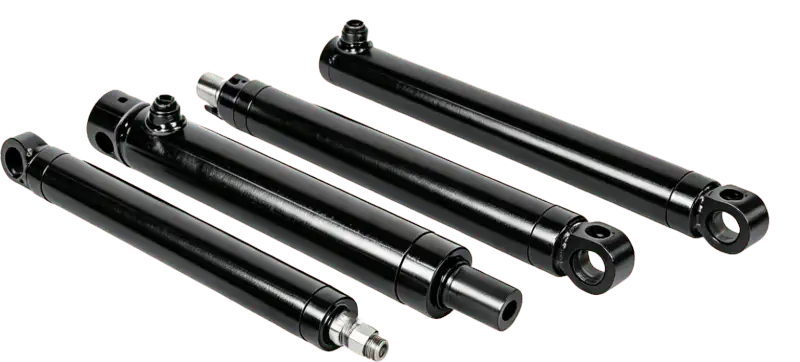
Core Structural Breakdown: Inside the Oil Cylinder
The elegance of the single-acting oil cylinder lies in its simplified architecture. By eliminating the need for a pressurized return stroke, several internal components are modified or removed altogether.
1. The Cylinder Tube (Barrel)
The highly polished seamless steel tube houses the pressure. In a single-acting cylinder, only one end of the tube requires a high-pressure hydraulic port.
2. Piston & Piston Rod
The piston transmits fluid pressure to the rod. Notably, the piston seal configuration is simplified; it only needs to prevent fluid bypass in one direction (the pressurized stroke).
3. The Breather Port (Vent)
The non-pressurized side of the cylinder is not sealed off entirely. It features a breather port to allow air to escape as the piston advances and re-enter as it retracts, preventing a vacuum lock.
4. The Return Mechanism
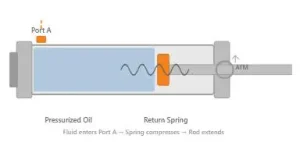
This is either an internal heavy-duty compression spring or a reliance on the physical weight of the machinery (like the carriage of Forklift Hydraulic Cylinders) to push the piston back.
Working Process: A Step-by-Step Step Analysis
To truly grasp how to choose the right hydraulic cylinder, you must understand the fluid dynamics occurring during its operational cycle.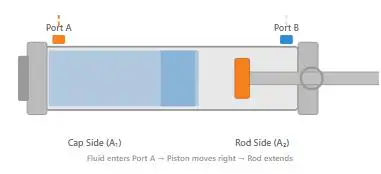
Phase 1: The Power Stroke (Extension)
- The directional control valve shifts, allowing the hydraulic pump to force pressurized hydraulic fluid through the single inlet port into the cap end of the cylinder.
- The fluid pressure acts upon the full surface area of the piston face.
- Once the generated force exceeds the resistance of the load (and the internal spring, if equipped), the piston and rod are pushed outward, performing mechanical work.
- Simultaneously, the air trapped on the opposite side of the piston is expelled through the breather port to atmosphere.
Phase 2: The Return Stroke (Retraction)
- The operator releases the control valve, shifting it to the neutral or exhaust position. Pump flow is blocked, and the cylinder’s oil port is opened to the hydraulic reservoir tank.
- With the hydraulic pressure removed, the external force takes over. Load-return cylinders use the weight of the hoisted object to push the piston down. Spring-return cylinders use the decompressive force of an internal mechanical spring to pull the rod back.
- As the piston retracts, it pushes the hydraulic fluid out of the cap end, back through the hose, and into the reservoir. Concurrently, fresh air is drawn into the rod end through the breather.
Single-Acting vs. Double-Acting: A Visual Comparison
Procurement managers often consult top Hydraulic Cylinder Suppliers to determine if an application warrants a double-acting upgrade. The choice fundamentally alters system design.
| Feature | Single-Acting Cylinder | Double-Acting Cylinder |
|---|---|---|
| Power Direction | One direction only (Push OR Pull) | Both directions (Push AND Pull) |
| Hydraulic Ports | One port (Fluid enters/exits same port) | Two ports (Fluid alternates sides) |
| Return Mechanism | Gravity, load, or internal spring | Hydraulic fluid pressure |
| Piping Complexity | Low (Single hose) | Higher (Two hoses, complex valving) |
| Relative Cost | Lower | Higher |
Where are Single-Acting Cylinders Used? Typical Scenarios
Why specify a single acting hydraulic cylinder over a double-acting one? The answer lies in engineering efficiency. If gravity can do half the work for free, it is financially and mechanically inefficient to use pump power.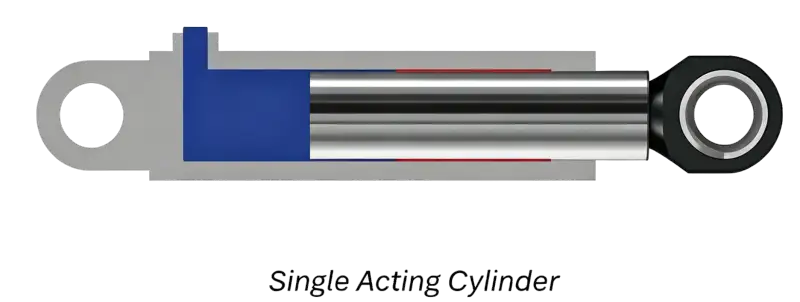
- Material Handling (Forklifts): The main vertical lift masts on forklifts are almost exclusively powered by single-acting telescopic cylinders. Pump pressure lifts the heavy forks and load. To lower them, a metered valve simply opens, and the immense weight of the carriage pushes the fluid back. This saves massive amounts of battery or fuel energy.
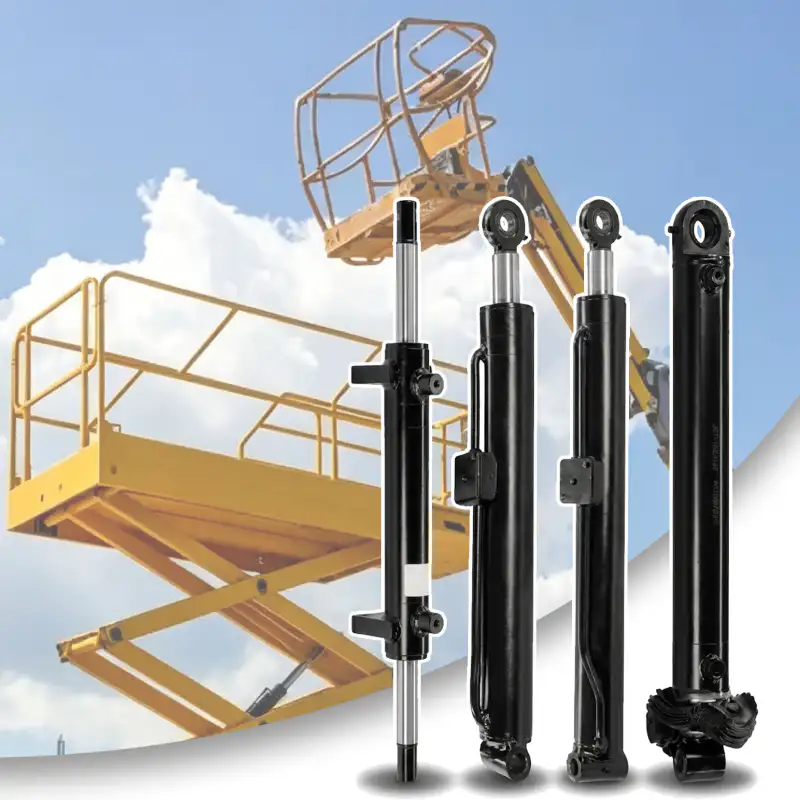
- Hydraulic Jacks and Scissor Lifts: Bottle jacks and automotive service lifts utilize single-acting mechanisms. They lift heavy vehicles vertically, and the vehicle’s mass guarantees a smooth, controlled descent when the release valve is opened.
- Dump Trucks: The massive multi-stage telescopic cylinders under the bed of a dump truck are single-acting Heavy-Duty Hydraulic Cylinders. They push the bed up to dump the load; once empty, the gravity of the heavy steel bed lowers it back to the chassis.
- Clamping and Tooling Jigs: In automated manufacturing, small spring-return single-acting cylinders are used to clamp parts firmly in place during machining. When pressure is removed, the spring instantly releases the clamp.
Clarifying Common Misconceptions: “Can it only push?”
A prevalent myth among novice designers is that single-acting cylinders can only push (extend) under pressure. This is false. A single-acting cylinder can be designed as a Pull-Type cylinder.
In a pull-type single-acting cylinder, the hydraulic port is located at the rod end (gland end) rather than the cap end. When pressurized, the fluid pulls the rod inward (retraction). When pressure is released, an internal spring (or an external load) pushes the rod back outward (extension). These are frequently used in specialized tensioning applications, brake mechanisms, and specific tooling fixtures.
Design Advantages & Application Limitations
The Advantages
- Cost-Effective: Fewer seals, fewer ports, and simpler valving reduce initial procurement costs.
- Reliability: A simpler design means fewer potential points of failure, streamlining Hydraulic Cylinder Maintenance.
- System Simplicity: Requires only half the hosing and simpler 3-way directional control valves compared to double-acting setups.
The Limitations
- No Controlled Return Force: You cannot precisely control the speed or force of the return stroke actively via pump pressure.
- Stroke Constraints (Spring Return): The inclusion of an internal return spring physically limits the maximum achievable stroke length and reduces the net pushing force (as pressure must overcome the spring tension).
- Environmental Ingress: The breather port can draw in dust or moisture during retraction. Proper breather filters are mandatory to prevent barrel scoring.
Partner with a Premier Hydraulic Cylinder Manufacturer
Whether you require robust single-acting telescopic cylinders for material handling or complex double-acting units for precision automation, off-the-shelf solutions often fall short. Your machinery demands engineering excellence.
Frequently Asked Questions (Engineering Focus)
How do I size the internal spring for a spring-return single-acting cylinder?
The spring must be calculated based on the maximum anticipated friction of the seals and bearings, plus the weight of the attached load (if working horizontally or upward), plus a safety factor. Note that the hydraulic pressure must be sufficient to overcome both the external load and the fully compressed spring force at maximum stroke. Consult our selection guide for detailed engineering calculations.
Why is oil leaking from the breather port of my single-acting cylinder?
A breather port is located on the non-pressurized side and should only expel air. If hydraulic oil is leaking from the breather, it is a definitive sign that the main piston seal has failed (bypassed). High-pressure fluid is leaking past the piston into the air chamber and being pushed out during the stroke. Immediate Hydraulic Cylinder Maintenance is required.
Can I convert a double-acting cylinder into a single-acting one?
Technically, yes. By leaving one port open to the atmosphere (acting as a breather) and only pressurizing the other port, a double-acting cylinder can function as a single-acting, load-return cylinder. However, you must install a highly efficient breather filter on the open port to prevent catastrophic dust ingress, and ensure the machine kinematics provide enough weight to force the fluid out during retraction.
“`